
Tazia Khushboo

I am a Ph.D. Candidate in Economics at the University of Calgary. I am an applied economist with research interests in labor and international economics. My work examines the incidence of trade policy changes and resource sector shocks.
I am on job market for the the 2025-2026 academic year.
Welcome
Research
Job Market Paper (JMP)
We study the spillover impacts of the 2014-16 oil price collapse, which caused substantial unemployment in the oil and gas sector, on workers elsewhere in the economy using Canadian matched employer-employee data. Displacement of co-worker networks in the highest-paying oil and gas sector can weaken workers’ outside options and bargaining power. Supply linkages to oil and gas and reliance on local spending by oil-and-gas workers can reduce the rents employers share with their workers. We construct three measures of exposure to the oil price shock corresponding to these bargaining, supply, and local demand channels. Exploiting variation in channel-specific exposure, we use a generalized difference-in-differences design to document persistent income losses. Relative to those least exposed, workers in the top 5% of shock exposure lost 4%, 5%, and 2% incomes annually along respective channels between 2014 and 2019. Individual income losses vary both by the channel of exposure and by workers’ relative position in the joint distribution of worker-firm matches. Aggregate income losses outside oil and gas are twice as large as those within the sector. Shocks originating in a high- paying resource sector thus affect a broad set of workers through distinct transmission channels and warrant targeted policy responses.
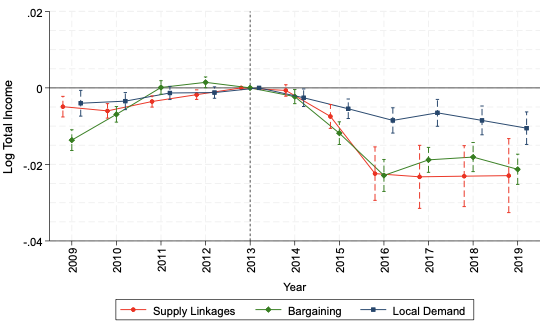
Notes. Impacts of exposure to the oil price shock through distinct channels: Employment networks are as just as important as production networks for sectoral shock propagation when the collapsed sector is a high-paying employer.Publication
Canadian Public Policy, 51(3): 319-43, 2025.
When the United States imposed tariffs on Canadian steel and aluminum in 2018, Canada responded with retaliatory tariffs on US goods worth $16.6 billion. I analyze how much of these tariffs passed through to import prices. The extent to which import prices increase because of tariffs is the tariff pass-through rate. A lower pass-through indicates that foreign exporters—rather than domestic importers—paid for most of the tariffs, implying better welfare consequences for the tariff-imposing country. Using Canadian import data and retaliation information, I exploit a triple-difference strategy to estimate the pass-through of Canada's retaliatory tariffs. On average, import prices increased to reflect the full tariffs, leading to zero terms-of-trade gains and welfare losses of $464 million. Thus, each dollar of the $1.76 billion tariff revenues raised imposed an average cost of $1.26 on Canadian importers. However, product-level analysis reveals that pass-through was incomplete for a subset of the targeted US products.
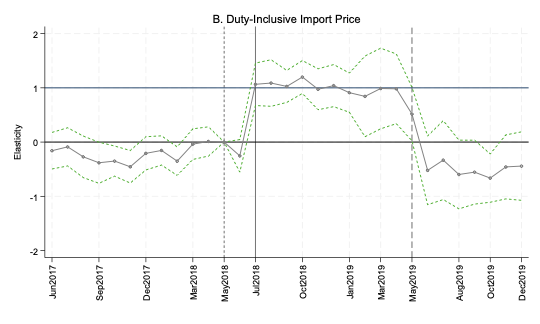
For targeted U.S. products, duty-inclusive import prices rise one-for-one with tariffs, implying full tariff passthrough. Building an HS8 Crosswalk between the U.S. and Canada: Machine Learning for Harmonized Code Concordance
Work In Progress
I create a crosswalk between U.S. and Canadian HS8 codes using machine learning methods to improve measurement precision in empirical studies of recent trade policies and tariff wars. The Harmonized System tracks international merchandise trade at varying granularity (two to six digits), but countries extend it with HS8 and HS10 codes that are not directly comparable. Because tariffs in the U.S. and Canada are implemented at the HS8 level, this mismatch prevents researchers from observing which U.S. exports face tariffs upon entry to Canada. My crosswalk resolves this gap. Leveraging similarity based on trade values and product descriptions between the two systems, I generate matches using competing machine learning models, with 263 product matches from Khushboo (2025) as ground-truth data. A semi-supervised self-training approach based on the Random Forest Classifier performs best on key evaluation metrics. The documented workflow can be adapted to build HS8 concordances for other country pairs.
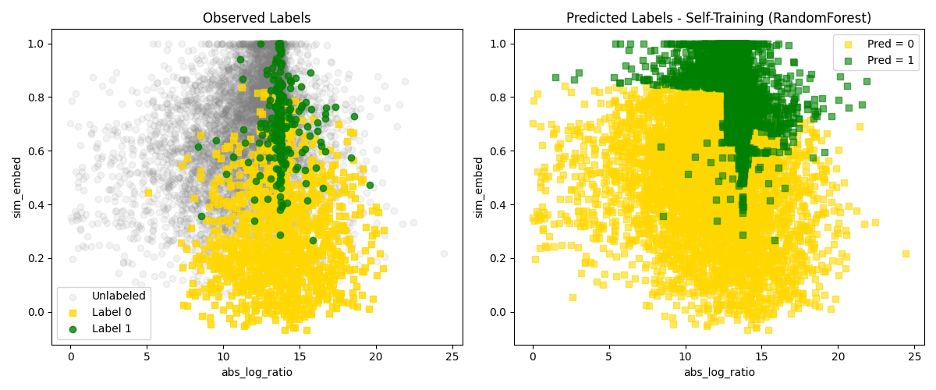
Notes. Self-training with Random Forest Classifier does a better job of labeling true matches that have lower textual similarity and are tightly centered in terms of trade similarity.Teaching Experience
Lecturer in Economics
Brac University
ECO 101: Principles of Microeconomics Spring/Summer 2019
ECO 201: Mathematics for Business and Economics Spring/Summer 2019
Sessional Instructor
University of Calgary
ECON 201: Principles of Microeconomics Summer 2025
University of Calgary
ECON 633: Graduate Labour Economics Fall 2024
ECON 201: Principles of Microeconomics Fall 2022, Winter/Fall 2024
ECON 301: Intermediate Microeconomics Fall 2019, Winter 2020, Fall 2020, Fall 2021
ECON 489: Economics of the Movie Business Summer 2020
ECON 491: Managerial and Decision Economics Summer 2020, 2021
ECON 303: Intermediate Economic Theory - Macroeconomics I Summer 2023
ECON 337: Development Economics Winter 2023
ECON 311: Computer Applications in Economics Summer 2024
ECON 405: Political Economy of Public Policy Winter 2021
Teaching Assistant
University of British Columbia
ECON 351: Women in the Economy Winter 2018
ECON 370: Cost-Benefit Analysis Fall 2017